The Fit-but-Sedentary Paradox: Why Your 6 a.m. Workout Doesn't Save You From the Other 10 Hours

Written By
Healthvizor

You are up at 5.45. Forty-five minutes in the gym by 7. Smoothie, shower, on your laptop by 9. From 9 to 7 p.m. you barely stand up. Calls, code, decks, Zoom, lunch at your desk. The commute is sitting. Dinner is sitting. Netflix is sitting.
You are disciplined. You are fitter than 90% of people your age. And yet, biologically, you have a problem that no amount of CrossFit will fully solve.
Researchers in inactivity physiology coined the term over a decade ago to describe a now-very-common pattern: an adult who hits or exceeds the recommended 150 minutes of moderate-vigorous activity per week and also sits for 9 to 12 hours a day. Despite ticking the exercise box, this group shows elevated blood glucose, elevated triglycerides, lower HDL, and higher waist circumference than their similarly active but less-sedentary peers. The exercise does not undo the sitting.
An American Heart Association scientific statement and a large meta-analysis of prospective cohorts both concluded that sedentary time is associated with cardiovascular disease and all-cause mortality independent of how much moderate-vigorous activity you do. Some studies even suggest the sedentary risk is most pronounced in people who otherwise meet exercise guidelines, possibly because they assume they are "covered" and stop noticing how little they move the rest of the day.
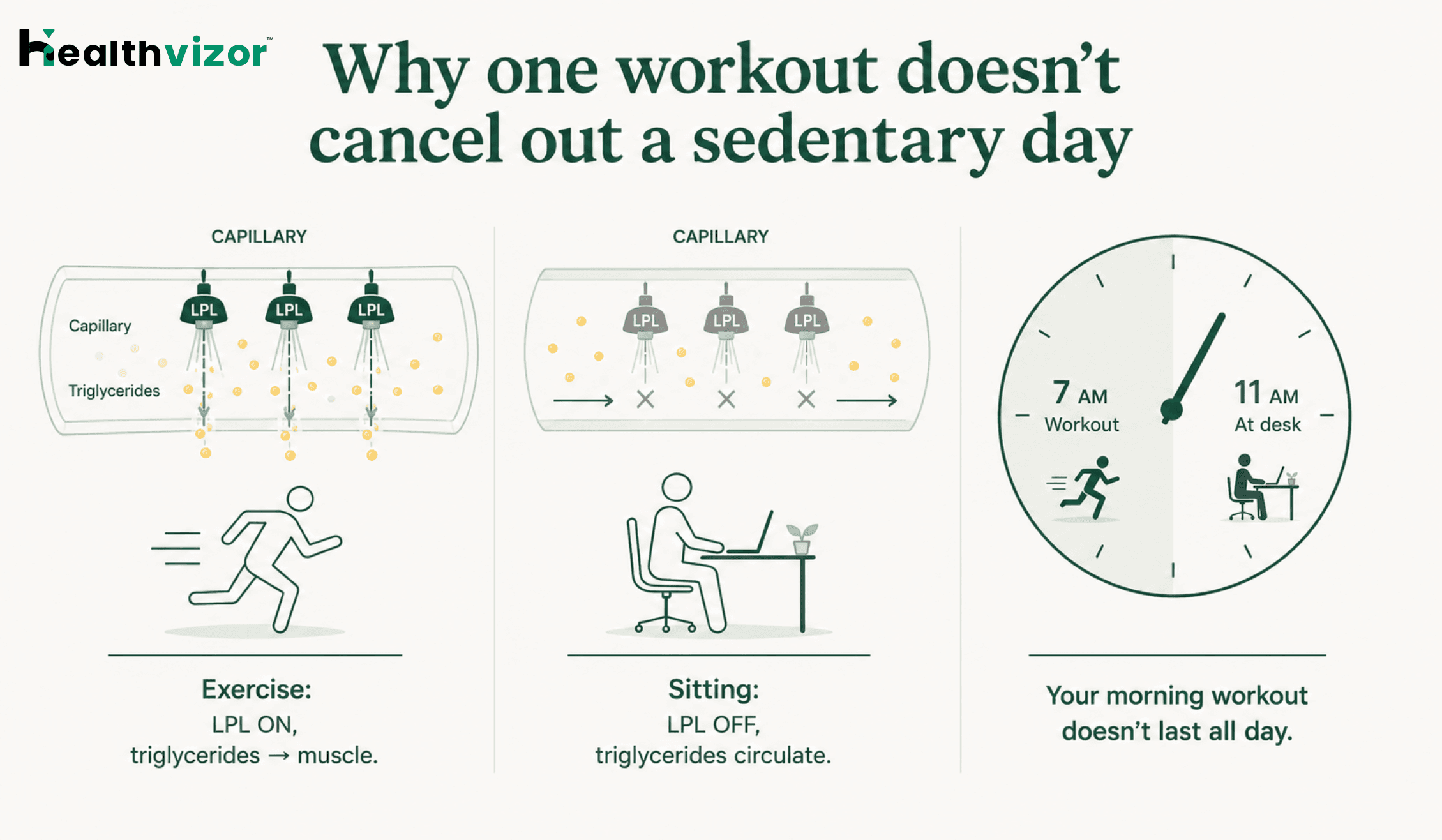
The biology is straightforward and slightly humbling. The enzyme lipoprotein lipase sits on the walls of your capillaries and pulls triglycerides out of your bloodstream into muscle, where they get used as fuel. LPL activity drops within an hour of sitting still. It does not matter that you trained at 7 a.m. At 11 a.m., having sat through three calls, your LPL is largely off. The triglycerides from your breakfast linger in circulation longer. Glucose disposal slows. Insulin has to work harder.
• Triglycerides drifting upward despite a clean diet and consistent training.
• Triglyceride/HDL ratio elevated, one of the earliest indicators of metabolic dysfunction.
• Fasting insulin and HOMA-IR creeping into the upper-normal range, even while HbA1c still appears reassuring.
• HbA1c and fasting glucose remaining within the "normal" range but trending upward year after year.
• hs-CRP persistently elevated, even with intense training, because prolonged sitting is itself mildly pro-inflammatory.
• Uric acid drifting upward, an often-overlooked marker associated with metabolic dysfunction and cardiovascular risk.
• ALT, AST and GGT gradually rising. Fatty liver frequently accompanies this profile, and GGT is often one of the earliest warning signs.
• Cortisol patterns flatter than they should be. Sustained low-grade desk stress can raise baseline cortisol while suppressing the normal morning peak.
• Free testosterone trending downward, particularly when poor sleep and prolonged sitting coexist.
• Visceral adipose tissue (DXA-VAT) higher than BMI would suggest. Common in TOFI phenotypes ("thin outside, fat inside"), with South Asians particularly vulnerable.
All of these are typically within the standard "clinical" range. They are not within the optimal range. This is exactly the gap Healthvizor was built to expose.

Adding another 60-minute workout to your week is rarely the answer if you are already training 4 to 5 times. The bigger lift is breaking up your sedentary blocks throughout the day. The research has converged on a now-well-supported tactic: micro-exercise breaks.
Standing up every 30 to 45 minutes for 1 to 3 minutes of light activity like calf raises, a flight of stairs, a short walk, or ten bodyweight squats restores LPL activity, blunts glucose spikes, and breaks the inflammatory drift of prolonged sitting. The doses do not need to be heroic. Frequency matters more than intensity.
Train as you already do. Keep your 4 to 5 times weekly structured sessions.
Reset every 45 minutes. Take a 2-minute movement snack: stand, walk, calf raises, push-ups, squats, or any movement.
Walk after meals. Even 10 to 15 minutes after lunch or dinner blunts the post-meal glucose spike substantially. This single habit has more metabolic impact than most supplements.
Stand for half your calls. Use a standing desk for one or two of the longest sitting blocks each day.
Take the long route. Walk to coffee, take stairs, park further. NEAT (non-exercise activity thermogenesis) is the metabolic difference between two adults with the same workout routine and very different bodies.
South Asians develop visceral fat earlier and at lower BMIs than other populations. The clinical pattern Indian doctors call "thin outside, fat inside" is in part a story of exactly this fit-but-sedentary lifestyle, layered on top of insulin-resistance-prone biology. A 5'10" Indian male at 78 kg with a 33-inch waist who trains 5 times a week can still have an MRI that shows substantial visceral adipose tissue. The labs catch it before the mirror does.
This is also where the "normal is not optimal" frame matters most. Your fasting glucose at 92 mg/dL will not trigger any alarm bells. Your HbA1c at 5.5% looks fine. But pair them with a fasting insulin of 13 µIU/mL, a triglyceride/HDL ratio of 2.5, and an hs-CRP of 2.8, and a GGT trending upward and a story is forming that is worth catching now, not in 2032.
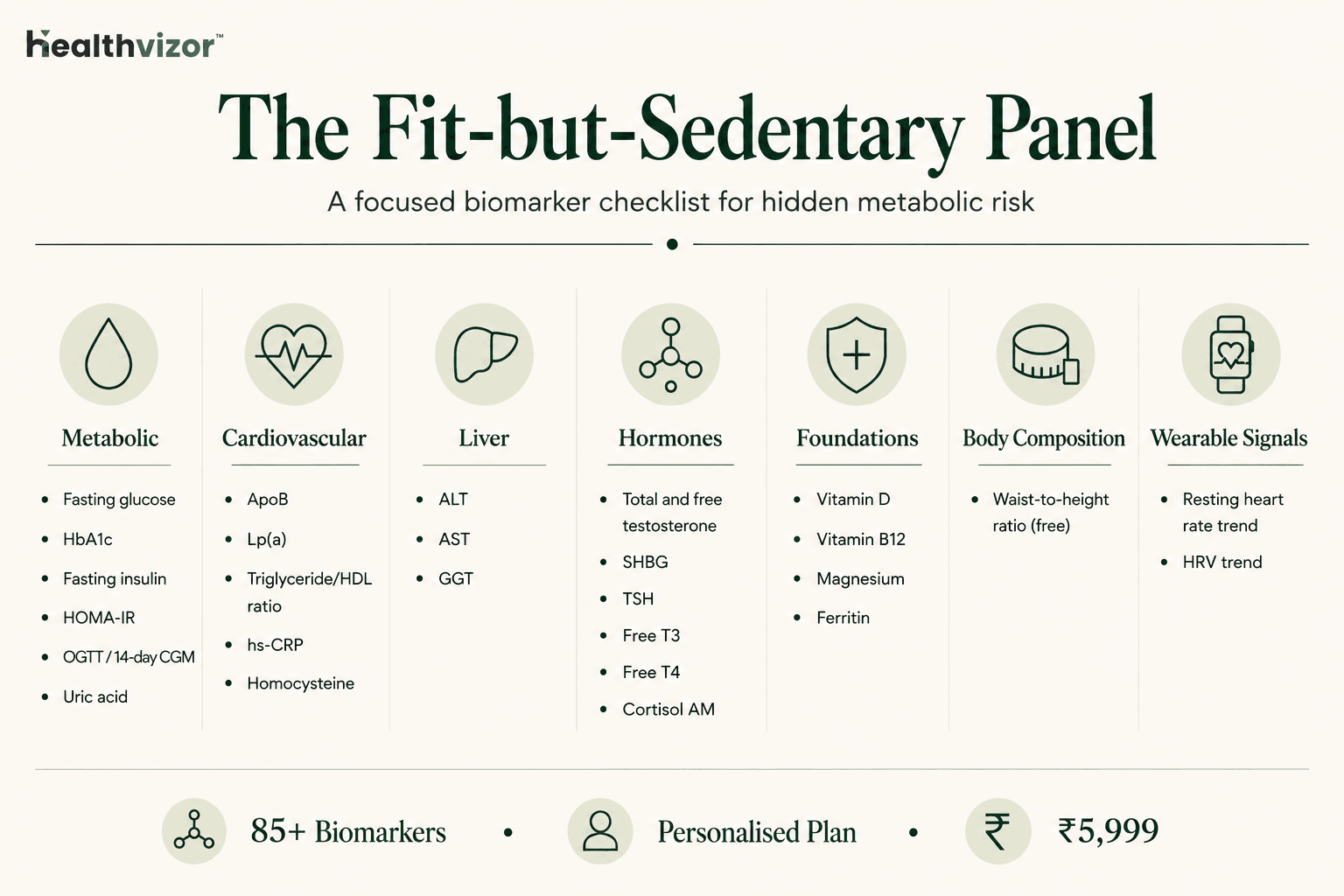
• Metabolic Health: Fasting insulin, HOMA-IR, HbA1c, fasting glucose, uric acid.
• Cardiovascular Health: Full lipid panel with ApoB, triglyceride/HDL ratio, Lp(a) (once-only test).
• Inflammation: hs-CRP, homocysteine.
• Liver Health: ALT, AST, GGT.
• Hormonal Health: Cortisol AM (and a 4-point salivary curve if you are feeling chronically wired), thyroid panel (TSH, Free T3, Free T4), total and free testosterone, SHBG.
• Foundational Nutrients: Vitamin D, B12, magnesium.
• Body Composition: Waist-to-height ratio.
• Recovery & Stress: Resting heart rate trend, HRV trend.
• Optional once: DXA scan for body composition and visceral fat. This is often more informative than BMI in lean-looking Indians.
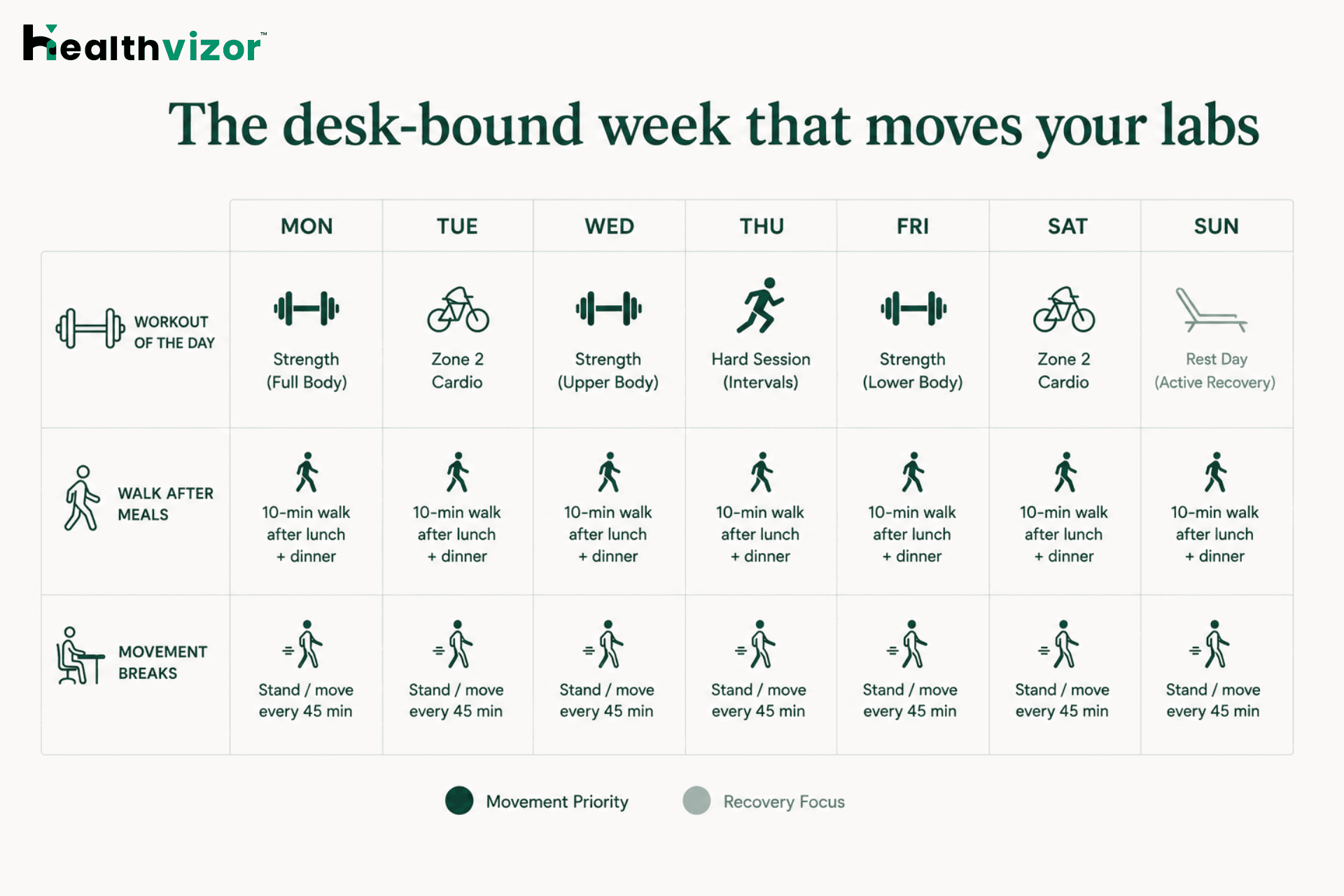
Theory is fine. Here is an actual week-shaped intervention that has produced measurable lab changes in office-worker cohorts:
Daily: a 10-minute walk after lunch and after dinner. This is non-negotiable.
Daily: stand-and-move every 45 minutes during work blocks.
3x/week: full-body strength training for 35 to 45 minutes using compound lifts.
2x/week: zone-2 cardio for 30 to 45 minutes at a nasal-breathing pace.
1x/week: one harder cardio session like intervals, a hard hike, or a pickup game.
Sleep: more than 7 hours with consistent timing.
Adults running this template alongside an office job have reliably moved fasting insulin, triglycerides, hs-CRP and ApoB in the right direction within 12 weeks.
Healthvizor's 85+ biomarker panel catches every part of the fit-but-sedentary profile, fasting glucose, HbA1c, fasting insulin, HOMA-IR, uric acid, ApoB, Lp(a), the triglyceride/HDL ratio, hs-CRP, homocysteine, ALT, AST and GGT for liver, the full thyroid panel (TSH, Free T3, Free T4, Anti-TPO), free and total testosterone, SHBG, DHEA-S, cortisol AM, vitamin D, B12, magnesium and ferritin, interpreted against an optimal range, not just a disease range.
A few of the advanced tests in the list above sit outside Healthvizor's standard panel, a 14-day CGM trial, a DXA scan, a full 4-point salivary cortisol curve. We'll tell you specifically where in India to get those, and how to read them alongside your Healthvizor results.
Your plan tells you which levers actually move your numbers given your training pattern, sleep and work setup. We don't want you doing more workouts. We want you to make sure the ones you're already doing aren't getting cancelled out by your laptop.